

Neria cibaria
Identification: Thorax: Humeri black
Head: Frons red-yellow, including the posterior half and up to the black ocellar triangle (unlike N. commutata which is black in the posterior half.) From the ocellar triangle dense white dusted areas extend rearwards onto the occiput.
Wing: Sc/R1 gap small
Male: The main image shows the S5 outgrowths drawing to a distal point. For detail see Malcolm Storey's image and Roháček's figure (5). Female image
Distribution
Europe: Countries (published), online at Fauna Europaea, Occurrences at GBIF
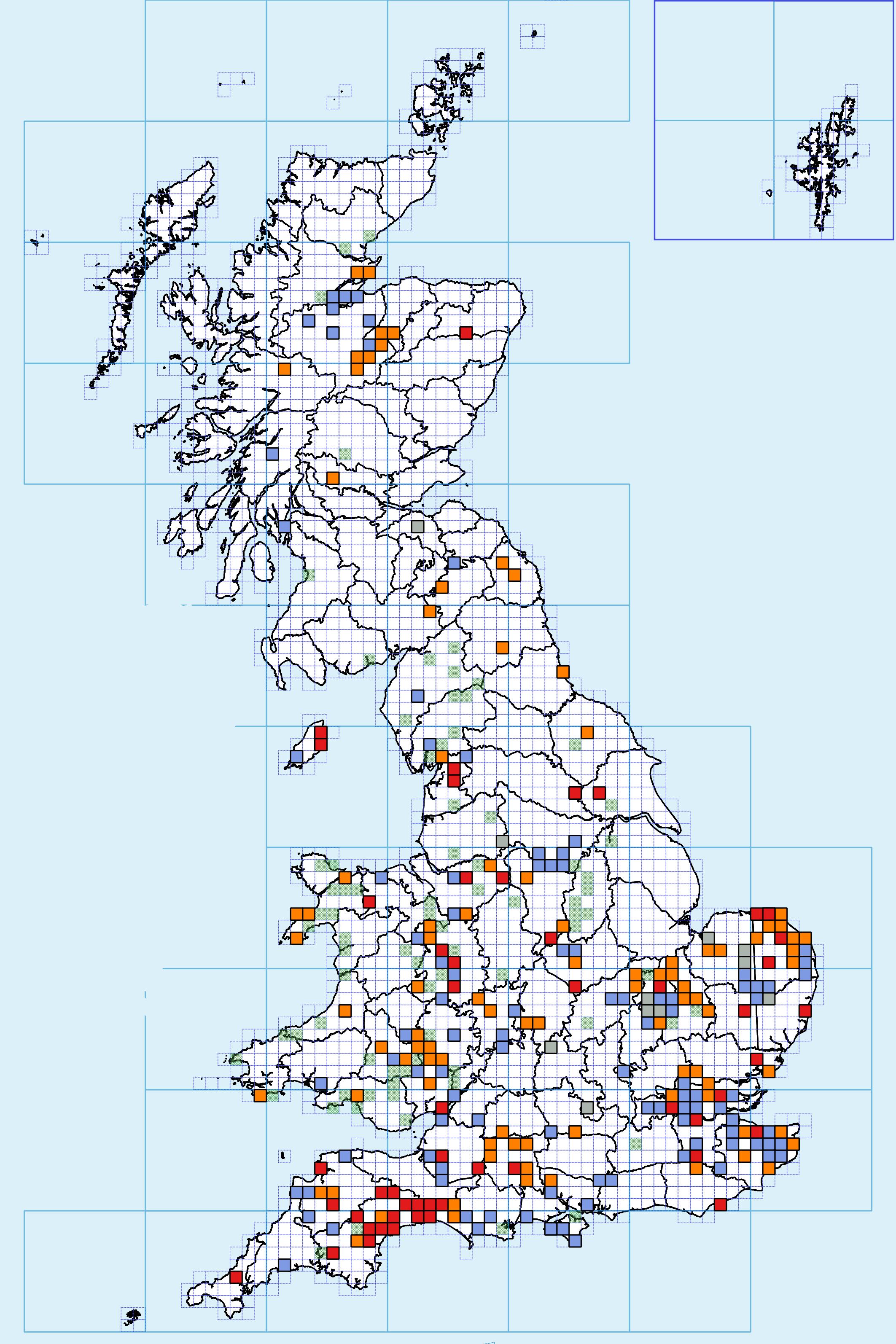
UK: Recording Scheme map of occurrences 2018 (verified, unverified records in green.) Online (NBN Atlas) via Easy maps or Interactive Atlas

A common theme for the Calobatinae seems to be ponded sediments of some nature. Ranging from small areas caused by water sources pooling alongside woodland tracks through gulleys in which vegetation helps retain sediment, to spring-fed overgrown pools and depressions by the side of lakes and rivers which are regularly inundated. Each of these supports plant communities of a different nature, one feature of which that seems significant is the presence of certain plant species with aerenchymatous roots such as the bulbous buttercup (Ranunculus bulbosus), the Celery-leaved buttercup (Ranunculus sceleratus) or Carex spp. Other tall herb vegetation is also necessary, such as nettles, a favourite for perching, displaying and grazing. The presence of tall shade shrubs and trees ensures humid conditions and helps maintain a continual rain of food in the form of droppings, dead insects and aphid honeydew.
The larvae of N. cibaria are saprophagous; there is a rearing record from a grass-heap in England (Ferrar 1987). Adult flies occur (commonly in C. Europe) in forested or bush- margined banks of rivers, creeks and in boggy habitats (Roháček & Barták 1990). ... on leaves of bushes and low vegetation from April to September. (Jindřich Roháček, 2016)
Predatory hypothesis: Colyer & Hammond (1951) reported observations of Neria cibaria with an aphid and hypothesised that the species is predatory. This hypothesis is repeated in subsequent works by other authors, right up to Stephen A. Marshall,s book Flies: The Natural History and Diversity of Diptera in 2012. The predatory hypothesis has been extended to the whole of the Calobatinae and even been ascribed to Micropeza.
Sucky hypothesis:
The labium is articulate with a sponge-like labellum at the end (see Malcolm Storey's images). The paired mandibles and maxillae are present, but reduced (not as much as a housefly). These characters are typical of a non-specialised sponging feeding mechanism. According to Giancarlo Dessì these structures are associated with a simple sucking function thus restricting the feeding opportunites to saprophagy, glycophagy (on honeydew and on exudates of aphids and other sedentary invertebrates), coprophagy, phytophagy (damaged leaves), pollinivory & necrophagy.
A video by Nikola Rahmé at https://www.flickr.com/photos/eurythyrea/7151629733 shows Neria cibaria running around on a leaf, at one point encountering a small dipteran - both run away from one another.
Writing of the Biology of the Micropezidae in 1973, Merritt & James state "There is relatively little known of the biology of the Micropezidae. Oldroyd (1964) stated that the adults are predacious on other insects, such as aphids and small
flies, which they stalk through the vegetation. However, our observations do not support this predation hypothesis. The mouthparts appears to be of the sponging type and not modified for predation."
Sumner, 2019