You are here
 Diopsoidea (5)
 Diopsidae (1)
- Megamerinidae (1)
- Psilidae (2)
- Chylizinae (1)
- Psilinae (2)
- Loxocerini (2)
- Psilini (4)
- Chamaepsila (38)
 Chamaepsila andreji
- Chamaepsila atra
- Chamaepsila bicolor
- Chamaepsila buccata
- Chamaepsila clunalis
- Chamaepsila confusa
- Chamaepsila ephippium
- Chamaepsila gracilis
- Chamaepsila hebraica
- Chamaepsila homochroa
- Chamaepsila humeralis
- Chamaepsila kaszabi
- Chamaepsila limbatella
- Chamaepsila longipennis
- Chamaepsila luteola
- Chamaepsila martineki
- Chamaepsila morio
- Chamaepsila nigra
- Chamaepsila nigricornis
- Chamaepsila nigrosetosa
- Chamaepsila nigrotaeniata
- Chamaepsila obscuritarsis
- Chamaepsila pallida
- Chamaepsila pectoralis
- Chamaepsila persimilis
- Chamaepsila problematica
- Chamaepsila pseudobicolor
- Chamaepsila quadrilineata
- Chamaepsila rosae
- Chamaepsila rozkosnyi
- Chamaepsila rufa
- Chamaepsila sardoa
- Chamaepsila setalba
- Chamaepsila strigata
- Chamaepsila tenebrica
- Chamaepsila triorbiseta
- Chamaepsila unilineata
- Chamaepsila villosula
- Oxypsila (1)
- Psila (4)
- Psilosoma (2)
- Strongylophthalmyiidae (1)
- Tanypezidae (1)
- Nerioidea (2)
Chamaepsila atra (Meigen, 1826)
Nomenclature
-
Tribe: PsiliniGenus: Chamaepsila




SUMMARY
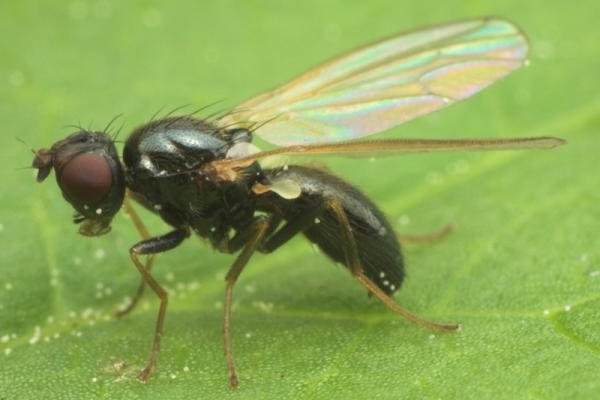
Shatalkin & Merz, 2010: This Transpalaearctic species is characterized by the presence of 4 dorsocentral setae, this character only shared with Ch. clunalis (Collin, 1944) in the Western Palaearctic Region. Ch. clunalis was described from Great Britain and was later found in Central Europe and Spain but is still unknown from Switzerland (Pape, 2007). It differs from Ch. atra by its larger epandrium in the male which gives the impression that the abdomen is parallel-sided (in Ch. atra more cone-like). Moreover, the posteroventral margin of the epandrium is extended into a tooth-like projection (Shatalkin, 1986, plate 4, fig. 9) (evenly rounded in Ch. atra). Finally, the female of C. clunalis has therefore a wider 7th tergite which is as wide as the previous one (decreasing in width in C. atra). C. clunalis exhibits a wide variation in colouration, varying from black to brown, especially on the head.
Key: Collin, 1944
Distribution
Europe: Countries (published), online at Fauna Europaea, Occurrences at GBIF
UK: Recording Scheme map of occurrences 2016 (verified.) Online (NBN Atlas) via Easy maps or Interactive Atlas
